
How Much Does Custom Software Development Cost in 2026?
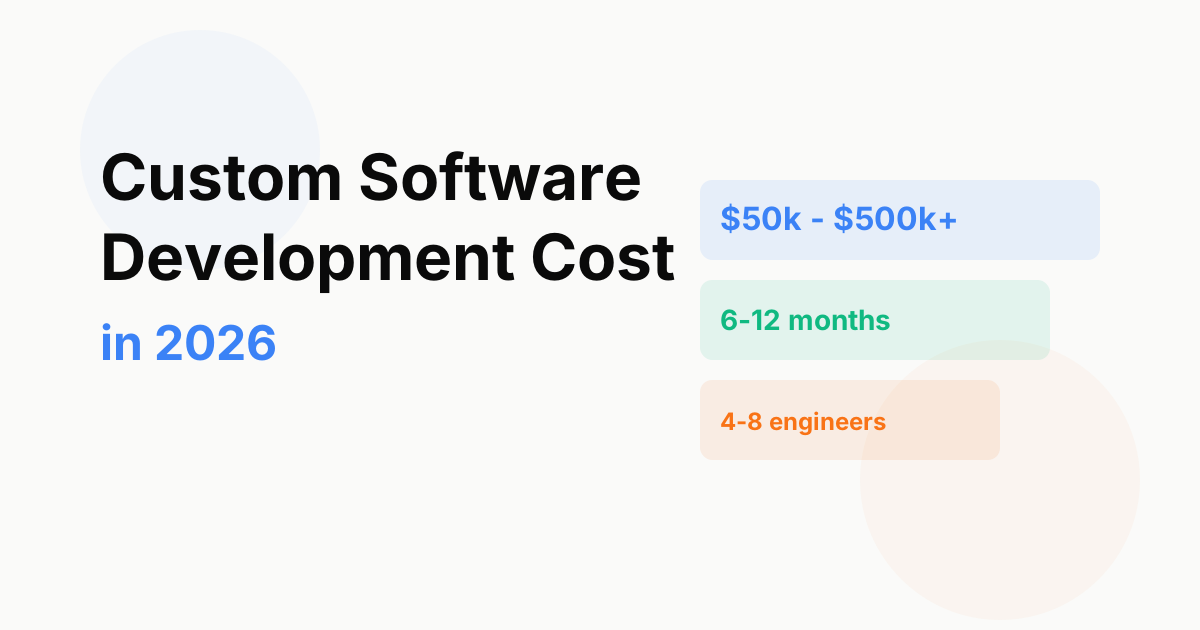
Custom software costs $50k to $500k+, but price is the wrong question. The real question is what you get for it — and whether the team you hire can ship it without bleeding scope.
A CEO asked me last week: “How much does custom software cost?” I asked back: “How much does a building cost?” The question feels reasonable until you realize it is asking for a number that depends on foundation depth, material choices, city permits, and whether the architect has built this shape before.
Custom software is the same. The range is $50,000 to $500,000+ for most B2B systems, and the spread is not arbitrary — it reflects decisions you make before the first line of code gets written.
This is what drives the cost, what you should expect to pay in 2026, and how to structure the engagement so you get the system you need without bleeding scope.
The cost range by complexity tier
Custom software breaks into four tiers based on system complexity, integration depth, and production requirements.
Tier 1: Internal tools and admin panels ($50k–$100k)
Simple CRUD applications with basic workflows. Customer data management, approval workflows, reporting dashboards. Usually built for internal operators, not external customers.
Typical specs:
- 3–5 core workflows
- PostgreSQL or MySQL database
- No complex integrations
- Internal users only (authentication, not authorization complexity)
- Basic reporting
Team shape: 2 senior engineers, 1 designer (part-time), 8–12 weeks.
Example: An internal order management system for a logistics company that replaces spreadsheets with a database-backed UI.
Tier 2: Customer-facing web applications ($100k–$250k)
Full production systems with external users, integrations, and performance requirements. B2B SaaS dashboards, customer portals, booking systems.
Typical specs:
- 8–15 user-facing features
- Multi-tenant architecture or role-based access
- 2–4 third-party integrations (Stripe, Twilio, etc.)
- Moderate traffic expectations (< 10k daily active users)
- Compliance considerations (GDPR, SOC 2 basics)
Team shape: 3–4 senior engineers, 1 designer, 1 PM/architect, 12–20 weeks.
Example: A customer onboarding portal with KYC verification, document upload, and status tracking.
Tier 3: Platform-grade systems ($250k–$500k)
Multi-service architectures with transaction integrity, real-time requirements, or regulated workflows. CRM platforms, payment gateways, ledger systems.
Typical specs:
- 15–30 interconnected features
- Microservices or modular monolith
- 5+ integrations with SLA requirements
- High availability and disaster recovery
- Audit trails and compliance reporting (SOC 2, PCI, HIPAA)
Team shape: 4–6 senior engineers, 2 designers, 1 architect, 1 DevOps, 20–32 weeks.
Example: A fintech lending platform with borrower onboarding, underwriting workflows, disbursement, and repayment tracking.
Tier 4: Mission-critical enterprise systems ($500k+)
Large-scale systems where downtime costs millions. Payment processors, healthcare platforms, supply chain orchestration.
Typical specs:
- 30+ features across multiple user personas
- Event-driven architecture with async workflows
- 10+ integrations with transaction guarantees
- 99.9%+ uptime requirements
- Full regulatory compliance stack
Team shape: 6–10 engineers, 3 designers, 2 architects, 2 DevOps, 6–12 months.
Example: A multi-country marketplace platform with escrow payments, KYC/AML, dispute resolution, and seller analytics.
What actually drives the price
The tier is a shorthand. The real drivers are more granular.
System complexity
The number of services, workflows, and integrations. A single-service monolith with 10 workflows costs less than a three-service system with the same 10 workflows, because coordination overhead between services is real.
Rule of thumb: Every service boundary adds 20–30% to build time. Every third-party integration with SLA requirements adds 1–2 weeks.
Data model complexity
How the system models relationships. An e-commerce catalog with products, variants, and categories is simpler than a financial ledger with double-entry accounting, transaction lineage, and reconciliation.
Rule of thumb: If the data model requires a whiteboard session longer than 2 hours, expect the database layer to add 30–40% to the build.
Compliance and security requirements
HIPAA, PCI-DSS, SOC 2, GDPR — these are not checkboxes. Each standard requires architecture decisions (encryption at rest, audit logs, data residency), testing (penetration tests, compliance scans), and documentation (runbooks, incident response plans).
Rule of thumb: Regulated systems cost 40–60% more than equivalent unregulated systems. SOC 2 alone adds $30k–$50k in audit prep and documentation.
Production readiness
The gap between “it works on my laptop” and “it survives Black Friday traffic” is the difference between a prototype and production software. Production systems need monitoring, alerting, CI/CD pipelines, staged rollouts, and a disaster recovery plan.
Rule of thumb: Production infrastructure adds 20–30% to the build. If the system needs 99.9% uptime, add another 20%.
Team seniority
A team of mid-level engineers costs less per hour but ships slower and makes more expensive mistakes. A team of senior engineers costs more per hour but ships faster and avoids the six-month rewrites.
Real cost example: A $200/hour senior team that ships in 12 weeks ($96k) beats a $100/hour mid-level team that ships in 24 weeks ($192k) and then needs a 12-week refactor ($96k).
Pricing models: fixed vs time-and-materials
Most custom software is priced one of two ways.
Fixed-bid projects
A single price for a defined scope. The agency takes the risk if the build runs long.
Pros:
- Predictable budget
- Clear scope boundaries
- Agency incentivized to ship efficiently
Cons:
- Scope changes are expensive change orders
- Agencies pad estimates to cover risk
- Quality suffers when the agency is underwater
When it works: Internal tools with well-known requirements. Simple integrations where the spec is stable.
When it fails: Anything customer-facing where you are still learning what users need. Any system with significant unknowns.
Time-and-materials (retainer)
Monthly or weekly rates for a dedicated team. You pay for the team’s time, not a fixed deliverable.
Pros:
- Flexibility to pivot based on learning
- No change-order friction
- Team incentivized to solve the problem, not defend the estimate
Cons:
- Open-ended cost if not managed
- Requires active product leadership from your side
- No guaranteed delivery date
When it works: Anything product-shaped where the right feature set is still being discovered. Growth-stage SaaS, marketplaces, platforms.
When it fails: Projects with hard deadlines (regulatory go-live dates) or fixed budgets where overruns are not an option.
Hybrid: scoping sprint + fixed monthly rate
The model we use at Dashhold — one week to scope, then fixed monthly rates for a pod. The scope defines the outcome, not the feature list, so pivots are built into the contract.
Pros:
- Budget predictability (fixed monthly cost)
- Flexibility to learn (outcome-based scope)
- Aligned incentives (we bill the same whether we ship 5 features or 15)
Cons:
- Requires trust that the studio will not milk the engagement
- Monthly burn is higher than hourly staff aug
When it works: Product engineering engagements where the customer has a clear outcome but uncertain feature set.
Hidden costs that blow budgets
Most software projects run over budget not because of bad estimates, but because of costs that were never in the estimate.
Integration complexity
“We just need to connect to Salesforce” turns into three weeks of debugging OAuth scopes, field mapping, and webhook retry logic. Every integration with a third-party API is a risk surface.
Mitigation: Budget 2x the happy-path estimate for every integration. If the vendor says “our API is simple,” triple it.
Compliance discovery
“We probably need SOC 2” becomes “we definitely need SOC 2, and also PCI because we touch card data, and also GDPR because we have EU customers.” Compliance scope expands as you learn.
Mitigation: Run a compliance audit during the scoping sprint. Surface the full list of standards before you estimate.
Data migration
“We will migrate the old system’s data later” is a trap. Data quality problems surface late, schema mismatches require backfills, and production cutover needs a weekend.
Mitigation: Budget 15–20% of the total project for migration if you are replacing an existing system.
Operational runbooks
The system is built, but nobody knows how to deploy it, monitor it, or respond when it breaks at 2am. Runbooks, on-call playbooks, and team training are real deliverables.
Mitigation: Make operational handoff an explicit phase. Budget 10–15% of the total for documentation and training.
What $150k gets you in 2026
Let me make this concrete with a real example: a SaaS onboarding platform for a fintech.
Scope:
- Customer onboarding flow (multi-step form with conditional logic)
- Document upload and verification (integrated with Onfido)
- KYC status dashboard for operators
- Email and SMS notifications (Twilio)
- Role-based access for customers, operators, and compliance reviewers
Team:
- 3 senior full-stack engineers
- 1 designer (part-time)
- 1 architect (part-time scoping and review)
Timeline: 16 weeks
Cost breakdown:
- Engineering: $105k (3 engineers × 16 weeks × $2,200/week)
- Design: $18k (0.5 designer × 16 weeks × $2,250/week)
- Architecture: $12k (0.25 architect × 16 weeks × $3,000/week)
- Project management (baked into engineering rate)
- Infrastructure: $5k (AWS, staging + prod environments, CI/CD)
- Testing and QA: $10k (penetration test, compliance scan)
Total: $150k
What you get:
- Production-grade system with 99.5% uptime target
- Full test coverage and CI/CD pipeline
- SOC 2-ready architecture (audit trails, encryption, access controls)
- Operational runbooks and deployment documentation
- 30-day post-launch support
What you do not get:
- A feature for every idea you had
- Real-time analytics (that is another $30k–$50k)
- Mobile apps (web-responsive only)
How to avoid cost overruns
A few tactical rules for keeping the build on budget.
Fix the team size, not the scope. Lock in the team composition and monthly burn. Let the scope flex based on what the team can ship in the timeline. This is how pod-based engagements work.
Cut features, not quality. If the budget is tight, ship fewer features at production quality. A small, correct system beats a large, broken one.
Front-load the unknowns. Tackle integrations, data migrations, and compliance in the first third of the build. Unknowns discovered late blow timelines.
Set a pivot budget. Reserve 15–20% of the total budget for scope changes and learning. If you never use it, great. If you need it, you are covered.
Demo every two weeks. Seeing the system in motion forces early decisions. Waiting until week 16 to demo is how you discover you built the wrong thing.
What you should actually pay
Here is what fair pricing looks like in 2026 for U.S.-based senior engineering teams.
Senior engineers: $150–$250/hour, or $6,000–$10,000/week fully loaded.
Designers: $125–$200/hour, or $5,000–$8,000/week fully loaded.
Architects: $200–$300/hour, typically part-time on engagements.
Offshore teams: $50–$100/hour, but expect 30–50% longer timelines and higher rework rates.
Staff augmentation: $100–$150/hour for warm bodies. You get what you pay for.
If you are quoted below these ranges for senior U.S. engineering, ask why. Usually it is offshore arbitrage, junior engineers labeled “senior,” or agencies underwater on their last engagement trying to keep the lights on.
When to build custom vs buy SaaS
Not every problem needs custom software. The decision rule:
Build custom if:
- The system is your competitive moat (payment gateway for a fintech, CRM for a vertical SaaS)
- No SaaS product does what you need without painful workarounds
- You are integrating deeply with internal systems
- Compliance or data residency rules out multi-tenant SaaS
Buy SaaS if:
- The problem is horizontal and solved products exist (email, analytics, support ticketing)
- Your competitive advantage is elsewhere
- You need to ship in weeks, not months
- The SaaS product is well-supported and API-extensible
The gray zone: SaaS platforms you can extend (Salesforce, HubSpot, Retool). These work when 80% of your needs fit the platform and you can build the last 20% on top.
How Dashhold prices engagements
We run fixed monthly retainers for dedicated pods. A standard pod is 2–4 senior engineers, 0.5–1 designer, and part-time architecture. Monthly burn is $40k–$80k depending on pod size.
Every engagement starts with a one-week scoping sprint ($8k–$12k, credited if you move forward). We surface the hypothesis, define the outcome metric, estimate the build, and decide together whether the path is honest.
If you want a structured conversation about whether your project is $100k or $300k, our strategy call is the fastest way. The studio’s services page lays out the practices we ship — fintech, CRM, dashboards, AI features, and marketplace platforms.
Frequently asked questions
Can I build custom software for under $50k?
Yes, if the scope is small (single workflow, internal tool, no integrations) and you hire directly or work with a small shop. Expect 4–8 weeks and a very narrow feature set.
Why is offshore development cheaper but often more expensive?
Hourly rates are lower, but communication overhead, time zone delays, and rework costs make the total cost higher. A $50/hour offshore team that takes 30 weeks costs more than a $200/hour U.S. team that takes 12 weeks.
What is the biggest mistake companies make when estimating cost?
Thinking about cost as “how much to build the first version” instead of “how much to build, deploy, maintain, and evolve the system for 3 years.” Total cost of ownership is the real number.
Should I hire in-house or contract an agency?
Hire in-house if you are building a platform that will be iterated on for years. Contract an agency if you need to ship a discrete system in 3–6 months and then hand it off.
How do I avoid scope creep?
Use outcome-based scoping, not feature-based. Define the metric you are trying to move, not the list of features. Let the team cut features that do not serve the outcome.
Closing thought
Custom software costs what it costs because software is not a commodity — it is a system built to fit a specific problem, and the cost reflects how well the problem is understood and how much production risk you are absorbing.
The number is not the insight. The insight is understanding what drives the number so you can make trade-offs intentionally: scope vs speed, quality vs cost, flexibility vs predictability.
If you are scoping a custom build and want a real estimate — not a range pulled from a blog post — our scoping sprint is the structured way to do it. One week, real engineers, a written proposal with the number and the reasoning behind it.