
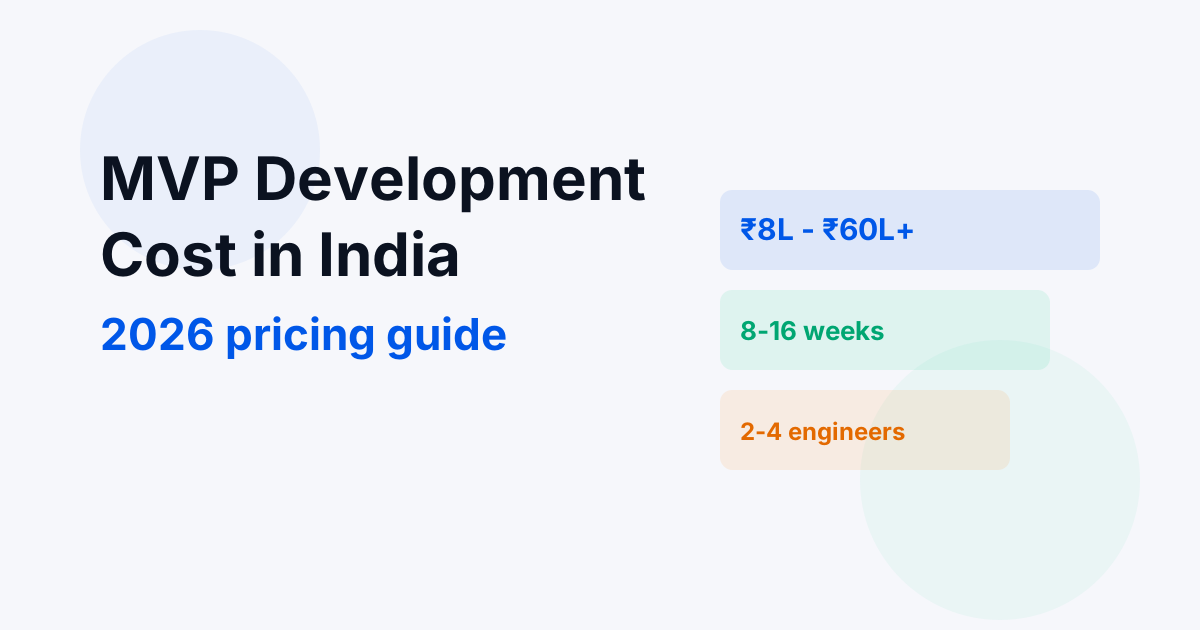
Founders ask us this every week: “How much does MVP development cost in India?” The honest answer is a range — ₹8 lakh to ₹60 lakh and up — and the spread is not random. It tracks the decisions you make before a single line of code gets written.
Dashhold is an India-based product engineering studio, and we scope MVP builds for funded founders across Delhi NCR, Bangalore, Mumbai, and beyond. This is the real breakdown of what an MVP costs here in 2026, what drives the number, and how to structure the build so you do not pay twice.
The MVP cost range by complexity
MVP development cost in India breaks into three tiers based on scope, integrations, and how close to production you need to be on day one.
Tier 1: Validation MVP (₹8L – ₹18L)
A focused build to test one hypothesis. One or two core flows, a clean signup, and enough instrumentation to measure whether people use it.
Typical specs:
- 2–4 core user flows
- Auth, a database, and basic analytics
- One payment or notification integration
- Web-first, responsive
Team shape: 2 senior engineers, part-time design, 8–10 weeks.
Tier 2: Production MVP (₹18L – ₹40L)
A real product you can put in front of paying customers. Multiple personas, billing, and the integrations your market expects.
Typical specs:
- 6–12 user-facing features
- Role-based access and multi-tenant data
- Billing (Stripe or Razorpay) plus 2–3 integrations
- Observability, error tracking, and CI/CD
Team shape: 3 senior engineers, a designer, part-time architecture, 12–16 weeks.
Tier 3: Funded-scale MVP (₹40L – ₹60L+)
A platform-grade first release for a well-funded team that needs to scale fast and pass diligence.
Typical specs:
- 12+ features across multiple personas
- Compliance considerations (data residency, audit trails)
- 5+ integrations with reliability requirements
- A codebase your future in-house team inherits cleanly
Team shape: 4–6 engineers, design, architecture, and DevOps, 16–24 weeks.
What actually drives the cost
The tier is shorthand. The real cost drivers are more specific.
Team seniority
This is the single biggest variable in MVP development cost in India. A junior-heavy shop quotes a low hourly rate, ships slowly, and hands you a codebase that needs a rewrite at Series A. A senior team costs more per hour, ships faster, and builds something that survives growth.
A senior team that ships in 12 weeks beats a cheaper team that takes 28 weeks and then needs a three-month refactor — every time, on both cost and calendar.
Integration depth
“We just need payments” becomes two weeks of webhook retry logic, idempotency handling, and reconciliation. Every integration with a third-party API is a risk surface. Budget two times the happy-path estimate for each one.
Production readiness
The gap between “works on my laptop” and “survives a launch on Product Hunt” is monitoring, alerting, staged rollouts, and a deploy pipeline. Skipping this makes the MVP cheaper today and far more expensive the week you get traction.
Compliance and data residency
If you handle payments, health data, or operate under Indian data-protection expectations, audit trails and encryption are architecture decisions, not afterthoughts. Regulated MVPs cost 30–50% more than equivalent unregulated ones.
Why India is a strong place to build your MVP
India has one of the deepest senior engineering talent pools in the world, and the cost of a senior India-based team is materially lower than a comparable team in the US or Western Europe — without the timezone and rework penalties of arms-length offshoring.
The trap is treating “India” as a synonym for “cheap.” The cheap end of the market is where founders lose the most money: a low quote, a junior team, and a rebuild a year later. The win is hiring a senior India-based studio that ships production-grade work at India rates.
What ₹25 lakh buys you in 2026
Let me make it concrete. A production MVP for a B2B SaaS startup:
Scope:
- Multi-step onboarding with conditional logic
- Subscription billing via Razorpay and Stripe
- An operator dashboard for the founding team
- Email and SMS notifications
- Role-based access for customers and admins
Team: 3 senior engineers, a part-time designer, part-time architecture, over 14 weeks.
What you get: a production-grade system with error tracking, a CI/CD pipeline, audit-ready data handling, runbooks, and 30 days of post-launch support. A codebase your first in-house hires can read.
What you do not get: every feature you brainstormed. Native mobile apps. Real-time analytics. Those are scoped as follow-ons once the core hypothesis is validated.
How to avoid overpaying
Fix the team size, not the feature list. Lock the pod and the monthly burn, and let scope flex to what the team can ship at quality.
Cut features, not quality. A small, correct MVP beats a large, broken one. Ship fewer flows, built properly.
Front-load the unknowns. Tackle integrations, data modeling, and compliance in the first third. Unknowns discovered late are what blow timelines.
Demo every two weeks. Seeing the product in motion forces decisions early, while they are cheap.
How Dashhold prices MVP development
We are an India-based studio that runs fixed monthly retainers for senior pods. Every engagement opens with a one-week scoping sprint where we lock the riskiest hypothesis, the metric that validates it, and the smallest releasable slice — then give you a written proposal with the number and the reasoning behind it.
If you want a real estimate instead of a range from a blog post, our startup MVP development practice and a quick strategy call are the fastest way to get one.
Frequently asked questions
How much does MVP development cost in India for a startup?
Most funded startups spend ₹8 lakh to ₹60 lakh depending on scope. A focused validation MVP starts around ₹8–18 lakh; a production MVP runs ₹18–40 lakh.
Is it cheaper to build an MVP in India than the US?
Yes, materially — a senior India-based team costs less per hour than a comparable US team. The savings are real only if you hire senior talent. Cheap junior teams cost more in the end through rework.
How long does MVP development take?
A validation MVP takes 8–10 weeks. A production MVP takes 12–16 weeks with a senior pod working in two-week sprints.
Should I hire freelancers or an agency for my MVP?
Freelancers work for tiny, well-defined scopes. For anything you will raise on or scale, a senior studio that owns the whole build and hands off cleanly is the safer path.
Closing thought
MVP development cost in India is not one number — it is a function of how well the problem is understood and how much production risk you absorb up front. The insight is not the price tag; it is knowing what drives it so you can trade scope, speed, and quality on purpose.
If you are scoping an MVP and want an honest estimate, our scoping sprint gives you a written proposal in a week — real senior engineers, real reasoning, real number.