
Product engineering vs traditional development: the real difference
Most teams hire engineering thinking they bought engineering. They actually bought ticket-takers. The difference between product engineering and traditional development decides everything.
A founder told me last year, “we hired a great engineering team and the product still feels stuck.” I asked what they shipped that quarter. He listed 14 features. I asked what changed for customers. He paused. The product had moved; the customers had not.
That gap is the difference between product engineering and traditional development. Both produce code. Only one produces leverage.
This is what I have learned about that difference across four years running Dashhold and the decade before it inside fintechs and SaaS companies. It is not academic. It is the lens I use when I scope a build and when I decide whether to take an engagement at all.
The shape of traditional development
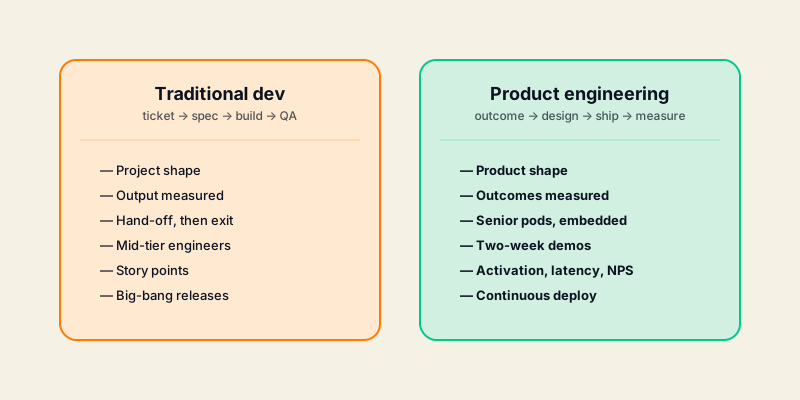
Traditional development is project-shaped. Tickets come in from a product manager. Engineers estimate them. Sprints get planned. Code gets written, code reviewed, QA’d, shipped. The team measures itself by velocity — story points completed per sprint, tickets closed, sprints completed on time.
The incentives reward predictability. Estimating well, hitting the sprint, leaving on time. The output is real and measurable.
It works in environments where the product is mature, the customer base is large, and the work is mostly maintenance and incremental feature requests. Banks operate this way. Enterprise software vendors operate this way. It is not wrong; it is fit-for-purpose for stable products.
The problem is that startups and growth-stage companies are not stable products. They are products discovering themselves, and traditional development calcifies the discovery process.
The shape of product engineering
Product engineering is product-shaped. The team treats the product as a hypothesis being tested every two weeks. The unit of work is not a ticket; it is an outcome — activation lifted, latency reduced, churn slowed. Engineers are part of the discovery loop, not downstream of it.
The incentives reward learning. A feature that ships and does not move the metric is a learning, not a failure. A feature that ships, moves the metric, and surfaces a deeper opportunity is a win. The team measures itself by what changed for customers.
This shape works in startups, growth-stage SaaS, and any product where the question of “what do customers actually need” is still open. It compounds, because every cycle teaches the team something the next cycle gets to use.
What this looks like in practice
The differences are not soft. They show up in concrete decisions.
Who writes the spec. In traditional development, a product manager writes a spec, hands it to engineering, engineering implements. In product engineering, the spec is co-authored. The engineer is part of figuring out what the right feature is, because they have context the spec cannot capture — what the system can support, what is cheap to build vs expensive, what alternatives exist.
Who owns the metric. In traditional development, the PM owns the metric. Engineering owns the implementation. In product engineering, the team owns the metric. If the feature ships and the metric does not move, the team iterates — they do not file a follow-up ticket and move on.
How estimates work. In traditional development, estimates are commitments. In product engineering, estimates are hypotheses. “We think this is two weeks” comes with “and the result we expect is X — if we do not see X by week 1.5, we change shape.” The estimate is a tool for learning, not a contract.
How features get cut. In traditional development, features get cut under deadline pressure with regret. In product engineering, features get cut deliberately — “this is not moving the metric and we have a faster path.” Cuts are routine, not crises.
What “done” means. In traditional development, done means shipped to production. In product engineering, done means shipped, measured, and either kept (because it worked) or rolled back (because it did not). Rollback is a normal step, not a failure mode.
The hiring problem
Most teams hiring “engineering” hire traditional developers and expect product engineers. The mismatch is a slow-burn disaster.
Senior engineers can usually do both. The shape they default to depends on incentives. A senior engineer in a ticket-driven environment becomes a ticket-driven engineer over time, because that is what gets rewarded. Move the same engineer into a metric-driven environment and they become a product engineer within a quarter.
Junior engineers can rarely do product engineering at all. The pattern requires enough context about systems, customers, and trade-offs to make the calls. Junior engineers are still learning systems; they cannot also be inventing features.
The hiring lesson: if you want product engineering, hire senior. If you cannot afford senior across the team, hire one or two product engineers as anchors and surround them with mid-level engineers who execute.
Why most agencies do not do product engineering
Most agencies are structurally bad at product engineering. The reason is the contract.
Fixed-bid contracts reward delivering exactly the spec, on time, on budget. Time-and-materials contracts reward billing hours. Neither rewards the agency for asking “is this the right feature.” The incentive is to take the spec, deliver the spec, and bill.
The studios that do product engineering well — and there are not many — structure their contracts around outcomes, not deliverables. A scoping sprint that produces a hypothesis, fixed monthly rates that decouple billing from feature count, and explicit conversations about cuts and pivots. The studio’s work-with-us page lays out the engagement shape we use, which is built around this difference.
The output gap is real
Two teams, same headcount, same year. Team A ships 50 features and three of them moved metrics. Team B ships 12 features and 11 of them moved metrics. Team B has 4x the leverage despite shipping 4x less.
This is not a thought experiment. It is the pattern across every engagement I have compared. Teams that move to product engineering ship fewer features and produce more impact. Teams that stay in traditional development ship more features and produce less impact.
The output gap shows up in the metrics that matter at the company level: net revenue retention, activation, churn, NPS. Traditional development moves them slowly. Product engineering moves them in cycles you can measure.
What this means for founders
A few practical implications if you are a founder picking how to staff or contract engineering.
The first 5 hires should be product engineers. They set the culture. If the culture is ticket-driven, every senior hire after will be ticket-driven by default.
Pick agency partners for the engagement shape, not the price. A ticket-driven agency at $50/hour will ship more features and move fewer metrics than a product-driven studio at $200/hour. Total cost of ownership is the metric, not hourly rate.
Resist the urge to over-spec. A 30-page spec assumes the answer is known. Most of the time it is not. A one-page hypothesis with explicit assumptions is more useful than a fully-specified feature.
Measure outcomes, not output. The metric that matters is what changed for customers, not what shipped. Make this explicit at the team level, the engagement level, and the company level.
Trust the team to cut features. A product-engineering team that never cuts features is not really product-engineering. The cuts are how the team learns. Reward them, do not punish them.
What this looks like inside Dashhold
Every engagement we run starts with a scoping sprint that surfaces hypotheses, not features. Every two weeks we demo the system in motion and decide together whether the next sprint should continue, pivot, or cut. Every feature ships with a metric attached. Every retainer client gets a quarterly review that asks “what did we learn this quarter, and what should we change.”
This is not a process invention. It is the shape every product-engineering team I have respected uses, just made explicit and contractual. It is what the studio means by senior product engineering.
Frequently asked questions
Is product engineering just agile with a new name?
No. Agile is a project-management framework. Product engineering is a hiring, contracting, and incentive shape. You can run agile inside traditional development (most teams do) and you can run product engineering with or without scrum ceremonies. They operate at different layers.
Do you have to be a startup to do product engineering?
No. Linear, Stripe, and Vercel run product engineering at scale. The constraint is incentives, not size. Companies that reward learning over predictability can do it at any size. Companies that reward predictability over learning will struggle, regardless of size.
Can I convert a traditional team to product engineering?
Slowly. Start with one product-engineering anchor, give them ownership of one metric, and let them set the shape for one team. Expand from there. A wholesale conversion in one quarter usually fails because the incentives have not moved with the structure.
How do I hire for product engineering?
Look for engineers who have shipped products, not just features. The interview question that reveals the difference: “Tell me about a feature you cut, and why.” Traditional engineers struggle with this. Product engineers have ten of them ready.
Closing thought
Engineering is not a commodity. The shape of the engineering you buy decides whether your product compounds or stalls. Traditional development is the right shape for some environments and the wrong shape for most growth-stage companies. Product engineering is the shape that produces leverage, but only if the incentives, contracts, and culture line up to reward it.
If you are scoping an engineering engagement and want a structured conversation about which shape fits your company, our strategy call is the fastest way. The studio’s work-with-us page lays out the engagement shape we use, which is built explicitly around the product-engineering pattern.